
Old Ammunition
Rates are rising. Inflation is sticky. The textbook says that's the end of the story. Make money more expensive and spending slows. Except this isn't a textbook moment.
We're living through technological change on a scale most generations never see. Not a better phone. Not a faster chip. Think horse to car. Think candles to electricity. Shifts like these rewire how an economy works and where capital goes.
Blackstone COO, Jon Gray, recently presented "Where's the Beef?" to his top 100 investors on AI. You can watch the full presentation here.
The best part is a short stretch where he talks about how much has changed in so little time. He talks about life in the 1800s and how it evolved in just 30 years.
Against that, central banks are using the tools they've always used. They're trying to fight a new boss with old ammunition, as my kids would say.
Torsten Slok, Apollo's Chief Economist, put numbers to it. He says the AI boom is causing "Dutch disease" in the US economy, pulling capital, power and labour away from rate-sensitive sectors like housing and autos. Those sectors are slowing, just as higher rates should make them. However, data centres aren't. Hyperscalers are driven by FOMO, not borrowing costs, and consensus forecasts for 2027 capex have kept rising even as rates went up. They're almost immune to what the Fed is doing.
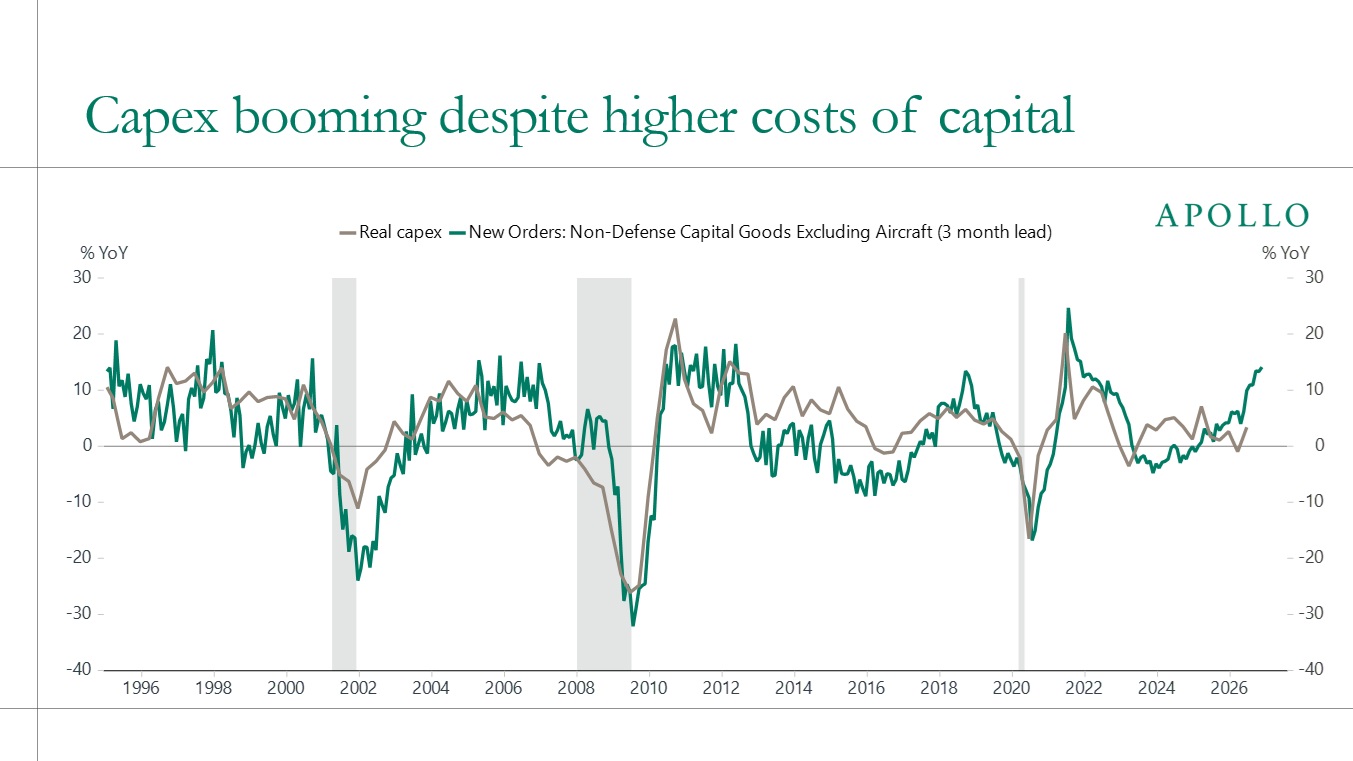
His conclusion is that AI spending and the One Big Beautiful Bill are both insensitive to interest rates, so rate hikes aren't slowing growth or inflation the way the textbook says they should. Rates can keep moving higher, and the Fed is stuck with higher for longer. Monetary policy can't fix an imbalance like this. The durable fix is more supply of power, chips and infrastructure.
Here's the thing though. Everyone is watching the Fed, as if markets only have one gauge on the dashboard to watch. Unfortunately it doesn't work this way.
Barry Ritholtz made this point this week. He listed twelve forces pushing yields higher, ranked by importance. The Fed came in sixth.
Number one is oil. Brent is above US$100, the Iran conflict is unresolved, and energy prices are up 16% on a year ago. Oil feeds into freight, food and heating, so it reaches almost every price and everyone.
Then growth. The AI build-out is lifting activity, and the Atlanta Fed's GDPNow estimate is 3.7%. A hot economy doesn't need cheap money. We've seen how that played out post COVID.
Then there is history. Ritholtz suggests the near-zero rates of 2001–2021 may have been the anomaly. From 1960 to 2007, the US 10-year averaged 6–7%. At 5% today, it's not an outlier. It might just be normal.
Then there is the rest. Deficits running at around 6% of GDP at full employment. Japanese yields at multi-decade highs, which gives the biggest foreign buyer of Treasuries less reason to buy them. And soft demand at long-bond auctions.
And here's where Slok and Ritholtz meet. AI capex shows up twice. It drives growth. And it's being funded in the bond market, roughly US$250 billion this year and up to US$400 billion next, competing head-on with the Treasury for the same investor dollars.
Each force is manageable on its own, but together, it's like 1 + 1 = 3, they compound. Then the market moves, and investors put it all down to the one thing they were already watching. It's called confirmation bias.
What it means for investors
The classic, "rates up, growth down" may not play out on schedule. Higher for longer could be longer than anyone has priced. And we may get a two-speed economy. We've seen it play out many times post COVID. The rate-sensitive parts (households, housing, leveraged property) carry the weight, while the AI build-out carries on regardless.
Australia doesn't get to opt out. Global bond yields come down to us whether we build data centres or not.
I believe many investors are still anchored to the low rates of the last 25 years and the pain of 2022. I guess central banks aren't the only ones using old ammunition.
Stop building a portfolio around one variable, because the market certainly isn't.
Take the long view.
Ready to grow your wealth?
Let's talk. One call. No risk. Just a way to see if we're a good fit.