
The Dreaded 5-Handle
The United States and Australian 10 Year government bond yield hit 5%. What does a 5-handle mean for investors?
There are two narratives being told at present. The first will tell you that higher borrowing costs push corporate margins lower and hurt the consumer, in turn, impacting equity markets adversely. Over and above this, higher rates mean bond and fixed income investments start to look attractive again, placing further pressure on equity markets. The other will tell you that we've been there, done that - interest rates were at these levels through the ninties and two thousands and equity markets did just fine.

Depending on which narrative you feel aligned to, investors need to understand how various levels of interest rates have impacted the stock market in the past.
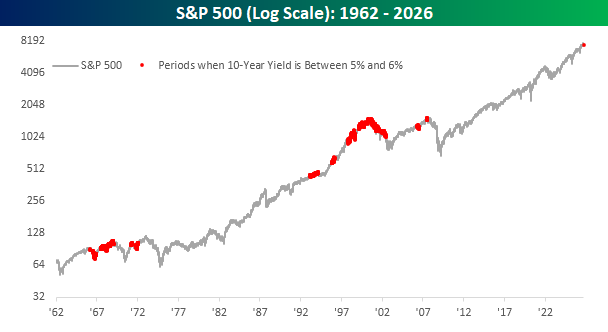
The chart below shows the S&P 500’s performance since the start of 1962. The red dots show periods when the 10-year US Treasury yield was between 5% and 6%. The last two times the 10-year yield was in this range was in 2007 and 2008, and then before that, it was the period leading up to and after the dot-com peak. So yes, yields were in this range in the late 1990s, but they were also in this range during the dot-com bust, and in the months leading up to the Financial Crisis.
Outside of these three periods, to find another period when the 10-year Treasury was between 5% and 6%, you have to go back to the late 1960s and early 1970s.
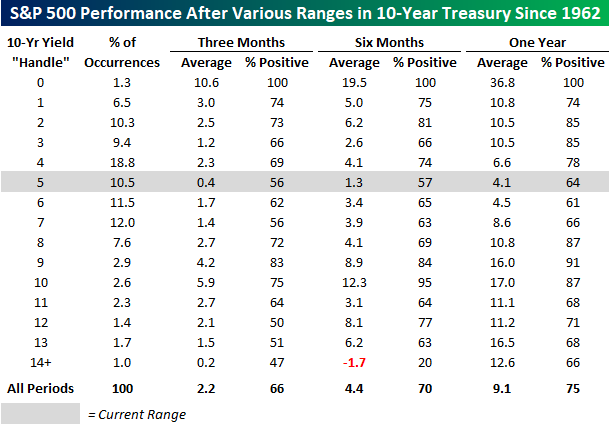
Let's look at how the stock market has performed at different yield levels. The table below shows how often the 10-year has traded in each "handle" (a 5-handle is anything from 5.00% to 5.99%), and the S&P 500's average return over the following three, six and twelve months.
A 5-handle ranks near the bottom. Its three- and six-month returns are the second weakest of any range, and its twelve-month return is the weakest. It's also one of the four most common handles (4% to 7%), and those are the only four where the average one-year return was under 10%.
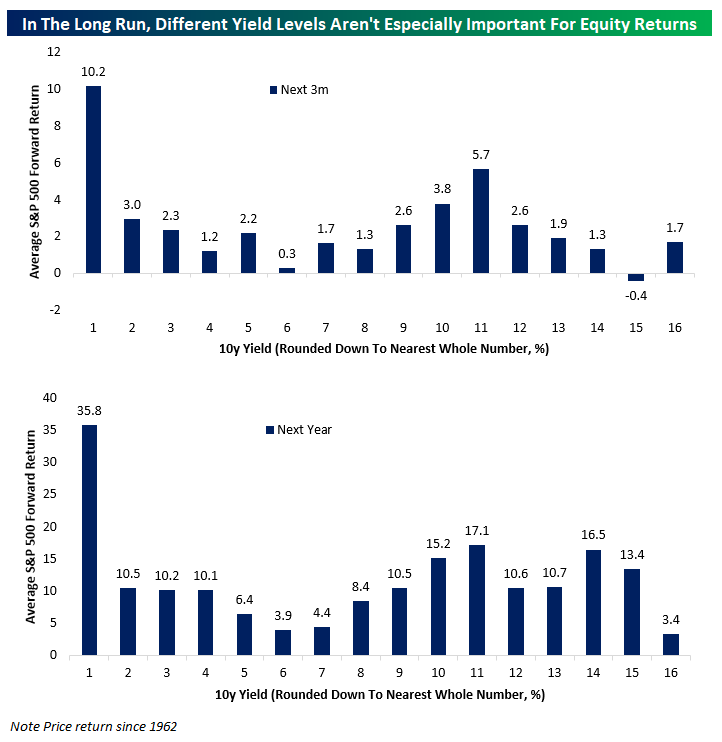
Presented differently:
A bond yield has two parts. The first is what investors expect interest rates to do over the next ten years. The second is the term premium - extra pay for the risk that those expectations turn out wrong.
When the term premium jumps, investors are nervous. They're worried about government deficits, or about a central bank that won't get inflation under control. Yields rise because of fear. That's the version that hurts shares.
But yields can also rise because the first part is climbing. Investors expect a stronger economy, and higher interest rates to go with it. Yields rise because of strength.
So which is it today? According to Bespoke, strength, and here's why: In August, short-term term premiums rose by about 0.2 percentage points, after Fed Chair Warsh's Jackson Hole speech opened the door to a September hike and early-September inflation data locked it in. But longer-term term premiums have been falling since mid-August.
The bond market isn't pricing in fear about inflation or government debt. It's pricing in a hotter economy, now and further out. That should mean stronger earnings, and it helps explain why the rapid rise in yields hasn't dented shares much so far.
Ready to grow your wealth?
Let's talk. One call. No risk. Just a way to see if we're a good fit.