
The Paradox of Active Management
We’ve been told this is becoming a stock picker’s market. Because volatility has returned, dispersion is beginning to widen, and the tide, finally, is no longer lifting all boats. In theory, this is where active managers should earn their keep. And yet, when we look at the most recent scorecard — 2025 — the outcome is familiar.
In 2025, 79% of U.S. large-cap active managers underperformed the S&P 500. Sixteen years in a row now where the majority of professional stock pickers have lagged the index.
Over longer horizons the picture becomes even starker:
- 89% underperform over 5 years
- 86% underperform over 10 years
- 93% underperform over 20 years
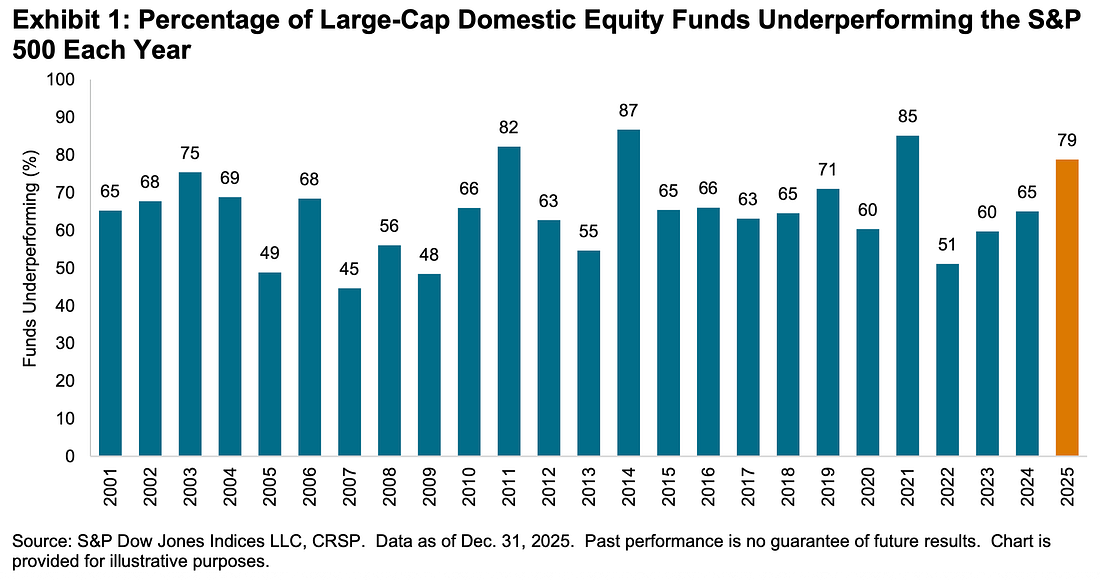
The conclusion seems obvious. Passive wins. But this year’s result carries a deeper irony. Because if there was ever an environment where active management should thrive, it was this one. Markets were volatile. Dispersion between winners and losers widened. Macro economic uncertainty dominated headlines.
These are precisely the conditions active managers point to when defending their craft. When everything moves together, indexing works. But when dispersion rises, skill should matter. And yet, even in this environment, the index still won.
In fact, according to new data from S&P Dow Jones Indices, 79% of U.S. large-cap equity fund managers underperformed the S&P 500 in 2025. It was the fourth-worst year for these managers in the report’s 25-year history.
The Mathematics of Markets
Part of the explanation lies in the structure of equity returns themselves. Stock market outcomes are highly skewed. A small handful of companies generate the majority of long-term wealth creation. The rest, often the majority, underperform the index or even Treasury bills.
You can see from the chart below, that only about 6% of stocks beat the market. That's a tough ask for even the professionals.

Owning the market ensures you capture those rare compounding machines. Missing just a few of them can mean missing most of the returns.
For active managers running concentrated portfolios, the odds become difficult very quickly.
The Illusion of Persistence
Even when skill does appear, it rarely lasts. There’s a reason every fund disclosure carries the same quiet warning: past performance is no guarantee of future results.
Not because it’s legal protection, but because it’s empirically true. Of the funds that outperformed in 2022, only a small fraction remained in the top half the following year. Fewer still sustained that performance into 2024.
Here are the persistence data over a three year period:

What this is telling us is that off the 519 funds that were around in December of 2022, 0.58% remained in the top quartile for 2023, and 0.19% in December of 2024.
And when the bar is raised (over five years), looking at the top quartile, persistence all but disappears.

Outperformance, it turns out, is not just rare. It’s fleeting. What looks like skill in one period often fades into randomness over time.
The Cost of Trying to be Different
Active management also carries structural headwinds. Higher fees. Higher turnover. Tracking error relative to benchmarks. To justify those costs, active managers must not only identify winners, they must identify enough winners to overcome the friction of being active. History suggests that’s a tall order.
Humility in Markets
None of this means active management is useless. There will always be exceptional investors who outperform. Markets will always reward deep insight, patience, and discipline. But the SPIVA data reminds us of something important:
Skill may exist — but it is rare, and difficult to identify in advance.
For most investors, the lesson is less about abandoning active management and more about embracing humility. Markets are complex systems. Even professionals with vast resources struggle to consistently beat them.
Sometimes the most sophisticated strategy is also the simplest: Own the market. Keep costs low. Stay invested.
In investing, as in nature, survival often belongs not to the most aggressive participants — but to the most adaptable ones. And increasingly, the index keeps adapting.
Ready to grow your wealth?
Let's talk. One call. No risk. Just a way to see if we're a good fit.