
What to do in Times of Uncertainty
The ongoing conflict in Iran and the rise in oil prices have been the primary reason for these wild swings in the market recently. Investors are trying to figure out whether or not these higher oil prices will slow the economy down and or drive inflation higher, and what all of this means for financial markets and company earnings.
To add to the confusion, we've got headlines on private credit, central banks, and how AI is taking everyone's jobs (?).
This ongoing tension in markets causes frustration with investors which leads to a burning desire to do something. Listen, I get it, watching your portfolio lose tens of thousands of dollars is not easy. Human beings seek control. It's a survival mechanism to manage anxiety, uncertainty, and fear.
The problem with this biological and psychological survival mechanism as it relates to financial markets, is that it causes unintended and unknowing destruction.
By the time you've read about what is happening in around the world, financial markets have already priced in their views. Headlines follow price. It's a lagging indicator. Let me say that again, the headlines you are reading today are about what happened yesterday.
Our primitive human brains are designed in such a way that we worry and dwell about the past and fantasize and fear the future. Yet, the present unfolds in front of us right now.
Remember when you designed your long-term investment portfolio? There was probably a bit of thought, data, and maybe some science that went into the design and construction of your portfolio. You probably have a defensive component, which may include things like cash and fixed deposits, and you probably have a growth component, which may include things like real estate and stocks.
And you probably designed your portfolio as a long-term, all weather portfolio that, when viewed through a wide lens, would withstand a variety of different attacks - inflation, deflation, rate rises, rate cuts, unemployment spikes, and whatever the economy through at it.
Yet, when your portfolio is tested in real time, when you, as an investor are tested in real time, you crumble. You have the human urge to react.
Let me tell you something. What you are seeing in markets and the way it is making you feel, is perfectly normal.
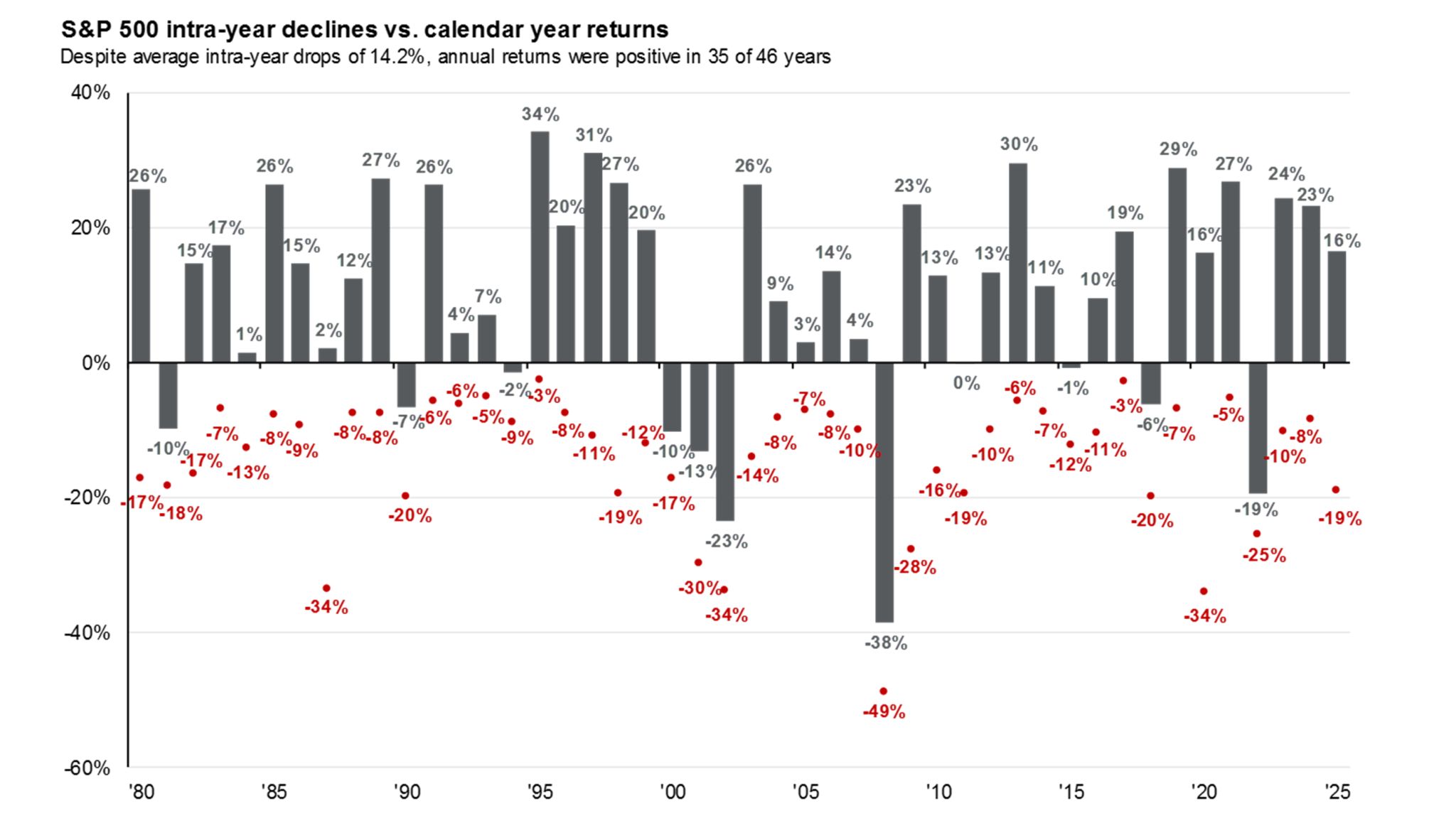
Don't believe me? Here is the data from Ned Davis Research illustrating the number of corrections and the magnitude of those corrections in the stock market each year. We see moderate corrections of 10% or more 1.1x a year.

Illustrated differently... this is one of my favourite charts. It shows us the stock market's calendar year return (grey bar) with the corresponding intra-year decline (red dot). On average, the stock market drops -14.2% each year, yet we see annual returns positive in 35 of 46 years - or 76% of the time.
Want to know what happens when you react to the headlines and your human instinct? Research has been done on this too. You lose. Badly. The famous Dalbar study shows us that the average investor has returned about 3% pa for the last 20 years (ending 2023) whilst the stock market itself returned about 10% pa.
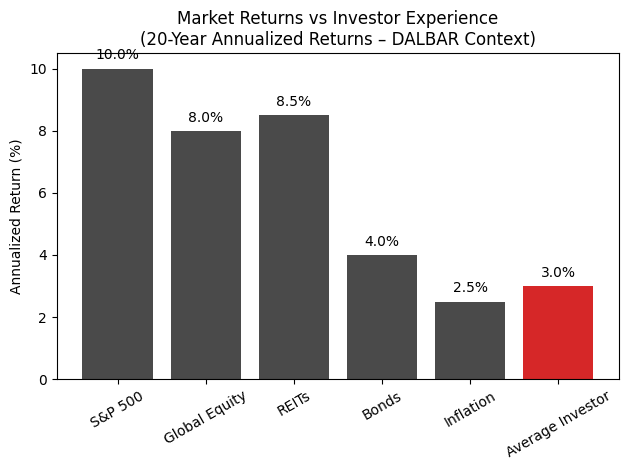
In dollar terms, a $100,000 investment translates to about $672,750 for the S&P 500 and about $180,611 for the average investor. That's a $492,139 gap. It's not just a return difference, it’s nearly 4x more wealth by simply staying invested vs behaving poorly.
The market does the heavy lifting. Sometimes the investor just needs to get out of the way.
Take the long view.
Ready to grow your wealth?
Let's talk. One call. No risk. Just a way to see if we're a good fit.